Olynfilm Experience Design
How we designed the film-watching experience on Olyn.
- Role
- UX Designer
- Year
- 2024
- Client
- Olyn
- Duration
- 10 months · Ongoing
( Overview )
Olyn is a two-sided platform: filmmakers on one side (film onboarding, publishing, monetization), viewers on the other — a one-link streaming page generated when a filmmaker publishes. The viewing experience is what gets shared, and what generates filmmaker revenue. If the viewer-side experience is weak, the entire filmmaker value proposition collapses.
- Role
- UX Designer
- Timeline
- Ongoing
- Deliverables
- UX Research, Wireframes, Prototypes, UI Design
- Goal
- Design the user interface for Olyn's consumer-facing product
( Context )
Olyn is a two-sided platform: filmmakers on one side (film onboarding, publishing, monetization), viewers on the other — a one-link streaming page generated when a filmmaker publishes. The viewing experience is what gets shared, and what generates filmmaker revenue. If the viewer-side experience is weak, the entire filmmaker value proposition collapses.
( Problem )
The film distribution industry has forced filmmakers to surrender their rights, audiences, and earnings data to platforms and studios. That power imbalance denies filmmakers access to their own audience and controls the ways in which they can distribute and earn from their content.
The industry data confirmed the pain:
- 83% of films distributed traditionally never recover their cost. Filmmakers don't know who watched, where, or why. (Filmmaker Magazine, 2022 survey of 104 indie filmmakers + Shorenstein Center at Harvard, 2024 US Independent Film Audience & Landscape Study)
- In 2024, the world released more than 6,750 films. Fewer than 2% ever reached a homepage. (Dark Skies Film 2024 release count + The Numbers + Box Office Mojo)
- The global creator economy reached an estimated $250+ billion in 2024–2025, growing at over 20% annually — driven by creators shifting to direct-to-fan models on Vimeo OTT, Gumroad, and Patreon. (SNS Insider Creator Economy Market Report 2025 + Vimeo + Gumroad)
( My Role )
I led the end-to-end design for the film viewing and payment platform — the consumer-facing surface that filmmakers' audiences see when they receive an Olyn link.
Stakeholders I collaborated with:
- Engineers (payment infrastructure, streaming, real-time states)
- Film regulators (content compliance, age ratings, regional restrictions)
- Filmmakers (advisory feedback throughout)
- Founders and product leadership
( Research )
The three user groups I designed for
The industry data told me the problem was real, but it didn't tell me who exactly to design for. So I ran three parallel streams of interviews to identify and validate who Olyn needed to serve.
- Filmmakers individuals who want to have their film on the platform and connect directly with their audience.
- Audience users who come to watch films uploaded by filmmakers.
- Partners creators and influencers who share and promote filmmaker content and drive virality of films.
Methodology
I ran three parallel streams of semi-structured interviews over four to six weeks, then synthesised the findings through affinity mapping in FigJam.
- 15 audience interviews active streaming users across Netflix, Prime, MUBI, and Apple TV. Mix of mainstream and curated viewers. 30–45 minute sessions.
- 8 filmmaker interviews independent directors at varying distribution stages (pre-, mid-, and post-distribution). Narrative and documentary. 45–60-minute sessions.
- 7 partner concept-test interviews high-reach creators with audiences overlapping film and culture, including Jordi Wild (The Wild Project). 30–60 minute sessions.
The current-state journey
Before proposing anything, I mapped the current experience for each group to understand where their pain lived.
Every journey ended the same way: with the user cut off from the other side of the relationship. Filmmakers cut off from their audiences. Audiences cut off from filmmakers. Partners cut off from impact. That pattern reframed the design problem — this wasn't a discovery problem. It was an ownership problem.
The three themes
After synthesising across all three groups, three themes recurred in every cohort:
- Theme 01 — Disconnection from the other side. Filmmakers from their audiences. Audiences from filmmakers. Partners from impact. The single most-recurrent theme across the entire study.
- Theme 02 — Ownership as the missing primitive. Every group described their pain as something they were denied — data, choice, or attribution — not as something that was broken.
- Theme 03 — Editorial framing beats transactional framing. Filmmakers wanted to feel like artists, not vendors. Audiences as discoverers, not consumers. Partners as curators, not advertisers.
Users and filmmakers didn't lack sophistication. They lacked ownership and connection.
( Goals for the MVP )
The research made it easier to define the scope and focus. Three goals emerged, one for each user type:
- Showcase the filmmaker's film clearly and professionally.
- Make it easy for viewers to watch or take action on the film page.
- Generate revenue and engagement for filmmakers and audiences on the film page.
( The Solution )
A film page experience that allows filmmakers to present their work confidently while enabling audiences to watch, share, and engage seamlessly and meaningfully.
( Process )
Competitive analysis
I studied how the major streaming platforms present films to understand what patterns had been established, what could be borrowed, and what needed to be reinvented.
From HBO and Apple TV, I took editorial confidence; they treat each show like it deserves its own world. From Netflix I took the importance of immediate CTA hierarchy. From Prime, I took how to surface monetisation without making it feel transactional. None of them solved for the third user type, the sharer, which is where Olyn diverges.
Content model
Based on the analysis, I created a content model that mirrors what the information presented on film pages is generically like — so every element could be edited by the filmmaker and rendered consistently across the page.
Insights that shaped the direction
- Don't reinvent interaction patterns — reinvent the meaning. Users pay for films they trust; the design job is to earn that trust in seconds.
- Preserve user attention and interest — the film page needs to feel like a magazine, not a marketplace.
- Support creator discovery and sharing — every viewer is a potential distribution channel.
( User Flows )
Two flows were the backbone of the payment experience:
First-time user flow
The full path from clicking Play to watching the film. The OTP step is marked orange because it's a friction point. I marked it deliberately: I don't want to hide compromises, and the friction unlocks something meaningful downstream.
Returning user flow
Because we authenticated the phone on the first purchase, every future purchase is one-click. The friction we accepted on Day 1 becomes the seamless one-click checkout on Day 2. That trade was one of the design decisions I'd defend hardest.
( The Final Design )
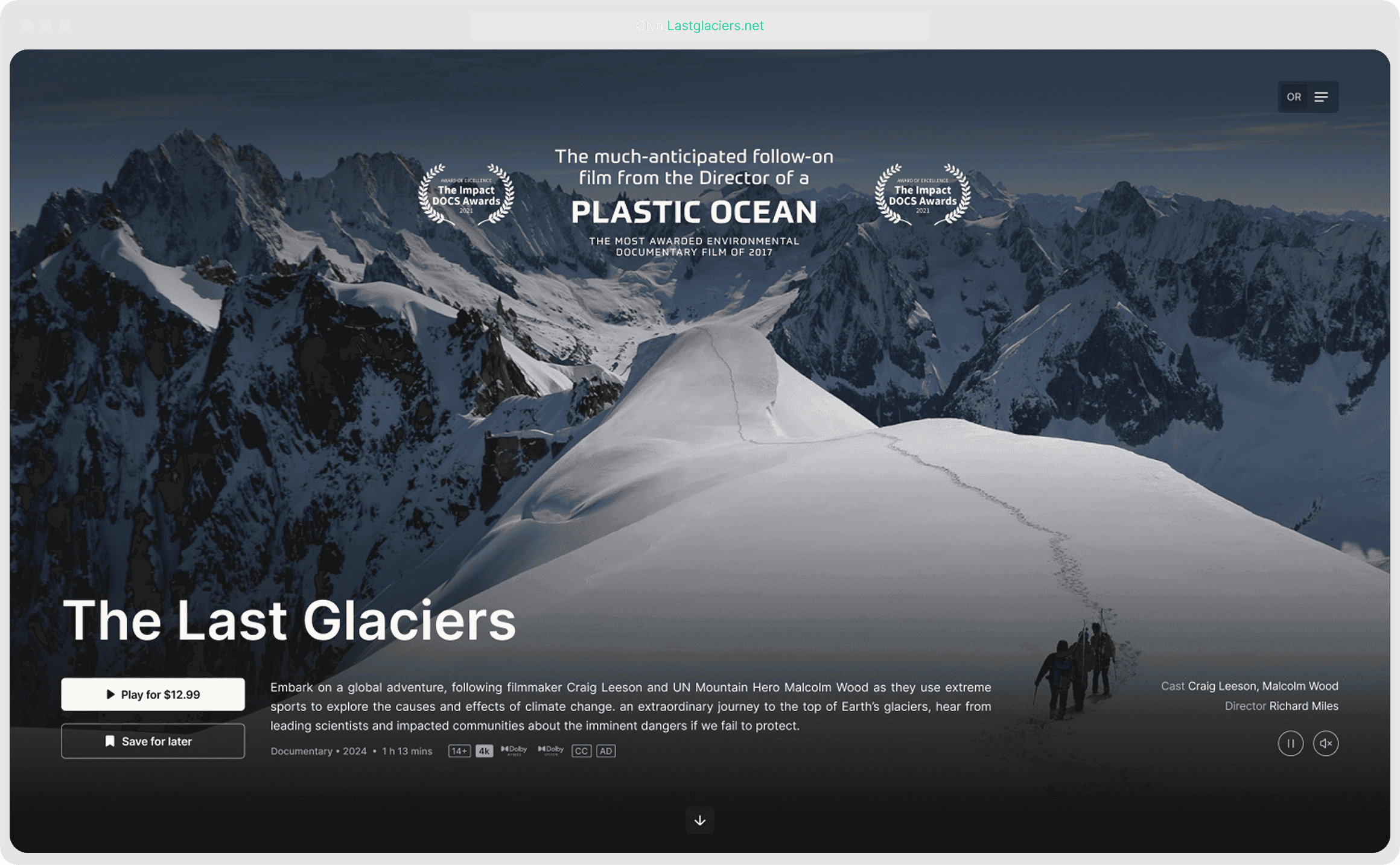
The moment a filmmaker sends a link and the audience lands on it is the product's most important moment. On most platforms, the platform logo dominates the hero. On Olyn, the film owns the top of the page, a deliberate design decision that made the ownership insight visible.
Seamless payment: incorporating a seamless payment and checkout experience which maintains and emphasises user engagement through share and earn.
Integrated sharing: sharing and promotion have been integrated into the solution to help foster an ecosystem where users promote and propagate the projects they love.
( User Testing and Feedback )
I ran usability testing on the hi-fi prototype and gathered feedback that shaped the next round of iterations.
- "There was a lapse in understanding of where to watch after making payment." This changed how I thought about success states. They're not the end of a flow; they're a re-orientation moment.
- "Users didn't understand where they could check how much they had earned from sharing a movie." This directly drove the dashboard redesign, surfacing Total Earned and Total Share Views as the primary panels.
( Impact )
Olyn launched in beta in late 2024 and gained traction with filmmakers, being part of the active ecosystem:
- 15 active film pages live; 42 additional screenings scheduled.
- Featured in 6 film festivals, including the prestigious Cannes and Tribeca.
- MAU up by 210%.
- Market presence: 3 new regions.
- Community size on Reddit, Substack, and Instagram up 200%.
This project proved something crucial: platforms own the filmmakers' viewers, denying them access to their audience and controlling the ways in which they distribute and earn from their content. Decentralising platform control and giving ownership back to filmmakers doesn't just help them — it helps everyone who is a fan of film and cinema.
+210%
Monthly active users
15
Live film pages, 42 more scheduled
6
Film festivals featured, incl. Cannes & Tribeca
+200%
Community growth on Reddit, Substack, Instagram
Next project
First Bank App Redesign