Enterprise Reward System
Digital reward system for marketing campaigns.
- Role
- Product Design
- Year
- 2021
- Client
- Interswitch
- Duration
- 6 months
( Overview )
The Digital Reward System (DRS) is a B2B product that helps corporate FMCG clients manage the reward process for their promos and marketing campaigns — simplifying how gifting and reward campaigns are created, distributed, and monitored, for a more efficient and less error-prone process.
( Quick Summary / Goal )
The Digital Reward system is a B2B product that helps companies manage the reward process for their promos and marketing campaigns. It is a system that simplifies the process of managing gifting and reward campaigns, meant to enhance the user experience of the process and provide a more efficient way of managing reward campaigns.
( Challenge )
Our clients are corporate FMCG companies that frequently run gifting and reward campaigns for their employees, customers, and partners. The current system of managing these campaigns is manual and time-consuming, leading to delays, errors, and dissatisfaction among the recipients. The client wanted to design a digital reward system that streamlines the process, allows for the creation of users and admins, reduces errors, and increases engagement and satisfaction.
( Approach )
We focused our design approach on existing studies and research carried out by the UX research team. They discovered that the current manual process of managing reward campaigns was time-consuming and error-prone, leading to delays and dissatisfaction among recipients. The end-users also wanted a more personalized experience that allowed them to choose their rewards and track their progress.
During our process we discovered that we had to design for different users with different levels of access — the product being a B2B product meant there were going to be specific people with access, so we discussed with potential users and the different companies we were working with, and came up with the following user profiles:
- The Super Admin the admin from the parent company side who has access to the entirety of the software.
- The Admin User the admin from the client company side who is able to create other users on the client workspace and manage their accessibility levels.
- Corporate User the user from the client company that has been given access by the admin user to make changes on the platform.
Market research: we conducted primary research to understand the market — examining a limited range of reward systems, SMEs, groups, and individuals who offer similar products, to understand how services are being run in the industry and connect user goals with business goals.
The Current Workflow for Reward and Incentive Systems
Problems observed:
- They were not able to make bulk campaign requests.
- There was little to no visibility on the side of the client, as it was the host that managed the entire system.
- There were no adequate ways to monitor the progress and status of campaigns that could tell the economic impact of the campaigns on client companies.
In digital reward companies, campaigns are the marketing giveaways and promos given to users of a particular product. The sustainability of reward systems depends largely on their ability to create an accurate process for monitoring and overseeing the campaign from start to finish — to be financially viable, DRS must ensure efficient and practical management quality based on monitoring and system efficiency.
How might we help effectively manage reward campaigns and foster efficient monitoring?
Due to the research, I was able to gather the issues with the present system, listed above. We discovered that the lack of visibility and the manual workflows made the current process very problematic for the users. After synthesizing data from surveys, interviews, and market research, I proceeded to define a solution hypothesis for each identified problem area.
Reward systems should be monitored from both the host side and the customer side, so that once the customer has visibility as to how the campaigns and engagements are going, DRS would avoid non-visibility and lack of transparency, and allow timely rework of the campaign parameters whenever there are errors from customers. My goal wasn't to redesign the business models of DRS, but rather to create a more efficient process of management — a monitoring system that highlights ongoing campaigns clearly and in time.
We discovered that the host having to manage the data of the customers themselves wasn't helping the system — important parameters were often left out due to overlapping information, and clients withheld or forgot to give a great deal of information, making the process difficult and unreliable. This is what DRS intends to solve: a measure to prevent campaign micromanagement in the first place, with effective methods to monitor the process.
( Key Areas )
- Detailed Onboarding a detailed onboarding process to be added for the client side of the digital reward software.
- Bulk Campaign Upload the client should be able to create and upload bulk campaigns for a more efficient process.
- Monitoring Dashboards both clients and host should have access to detailed dashboards featuring graphs and panels of campaigns and different parameters for monitoring.
- Digitized Campaign Configurations both clients and host should be able to configure campaigns with a full range of parameters provided.
( Design )
Based on the research findings, we designed a digital reward system with the following features:
- User-friendly Interface: a user-friendly interface that is easy to navigate and understand, visually appealing, with a clear call to action guiding the user through the reward process.
- Customizable Rewards: a reward catalog offering a wide range of rewards that can be customized to the user's preferences, with progress tracking toward achieving them.
- Campaign Management: a campaign management feature that allows the client to create and manage gifting and reward campaigns, setting goals, rules, deadlines, and tracking progress.
- User Profile Creation: allows users to create admins and give them different levels of access, from Super Admins to Corporate Admins to Corporate Users.
- Real-time Analytics: tracks the progress of the campaign, providing insights into user engagement and satisfaction so clients can optimize campaigns for better results.
( Competitor Analysis )
I conducted market research to understand what competitors were offering and identify potential opportunities. To my surprise, I found no existing solution in the Nigerian market specifically addressing the challenge of keeping track of promotions, giftings, and campaigns.
With the absence of any similar product in Nigeria, I was able to find one in the foreign market and performed a SWOT analysis to compare it with the potential of our DRS.
SWOT Analysis of XOXODAY in relation to DRS
Strengths
- XOXODAY has a lot of brands that they partner with.
- Easy integrations with third-party software.
- Has a fairly large user base.
- Provides a comprehensive list of different campaign types and categories.
Weaknesses
- XOXODAY is a very niche product that works for internal gifting.
- It doesn't really work for marketing campaigns, because the product is built for internal B2B companies.
Opportunities
- XOXODAY can expand its product offerings to accommodate more business needs and solve more problems.
Threats
- XOXODAY faces competition from other companies with similar offerings.
- They could lose customers and users to companies with a wider range of products.
Notes:
- Each individual box can be considered as a page.
- Information flows from left to right.
- Items grouped in a box denote widgets and options that can be displayed on the multiple pages.
Due to legal constraints, I am unable to post the process flows for the system, so I have intentionally omitted them here.
( Prototype )
We developed a prototype of the digital reward system that showcases the user interface, customizable rewards, campaign management, and real-time analytics. The prototype underwent user testing, and the feedback was positive, with users finding the reward system easy to use and engaging.
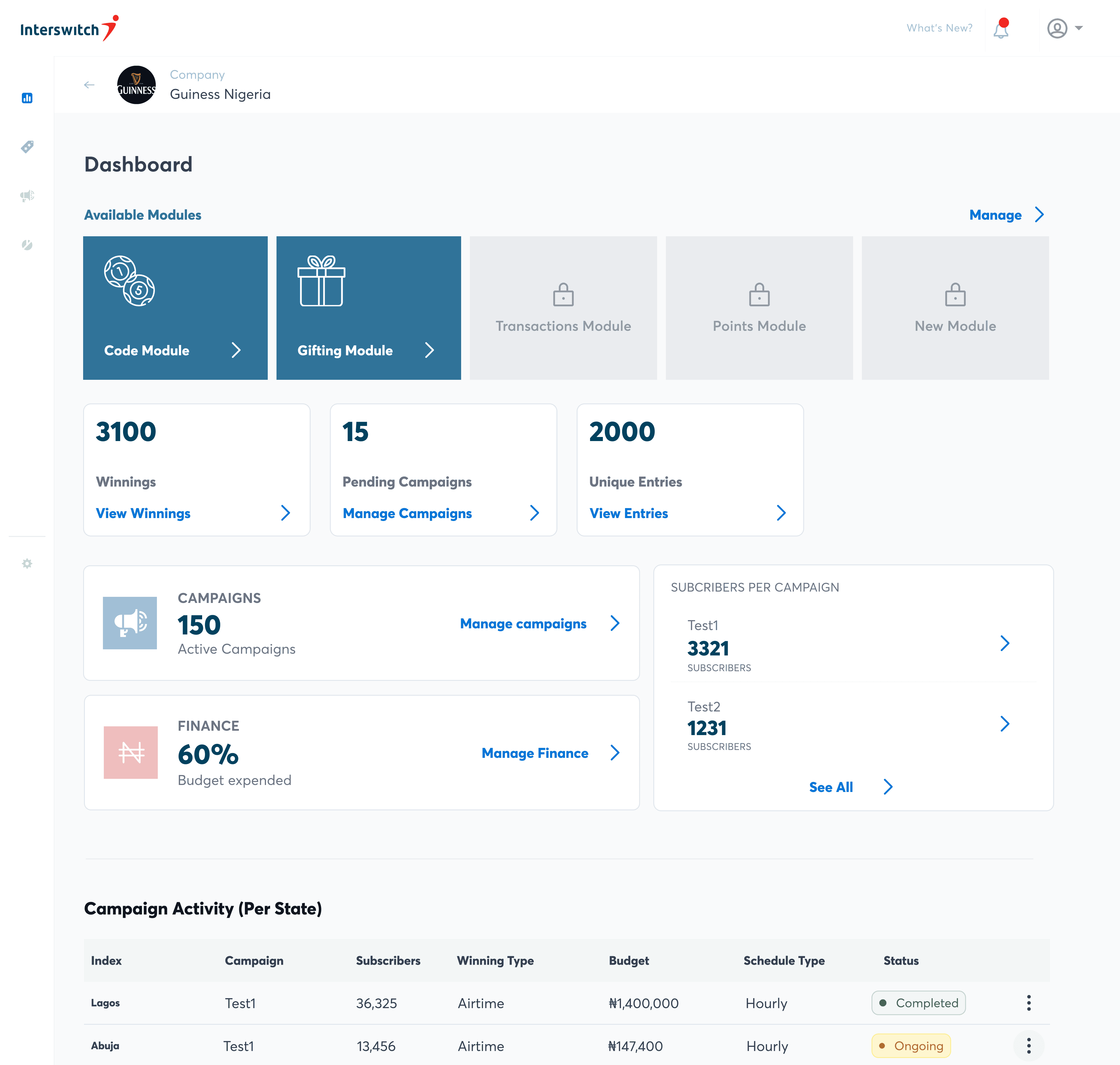
User Dashboard
We designed a dashboard through which a user or admin can track campaigns and monitor winnings and other deliverables done on the platform.
System Generated Reports
We designed a product that auto-generates accurate, up-to-date reports based on the data fed into and parsed through the system — helpful for clients analyzing their campaigns.
Campaign Management Module
We designed a module for accessing and monitoring ongoing campaigns and also starting new campaigns with all the requirements needed.
User Roles and Permission Management
We created a system for people to add new users from their organizations and give them permissions that suit the use case they are accessing the platform for.
( Implementation )
We worked closely with the client and project managers to implement the digital reward system, which included migrating the existing campaign data to the new system and training the client's staff on how to use it effectively. We also provided ongoing support to ensure the system runs smoothly and resolves any issues that arise.
( Business Impact )
The new DRS design helped increase our client's efficiency — we saw a 72.4% increase in campaign success for clients, compared to the former 51.8%. The system's customizable rewards, campaign management, real-time analytics, and multi-platform access features make it a robust platform that enhances user experience, increases engagement and satisfaction, and improves the overall reward campaign's effectiveness. We recorded a 22% reduction in error and issue logging by customers since the release of the new design.
( Conclusion )
The digital reward system designed for our client has proven to be an effective solution to streamline the process of managing gifting and reward campaigns. Its user-friendly interface, customizable rewards, campaign management, real-time analytics, and multi-platform access features make it a powerful tool for enhancing user experience, increasing engagement and satisfaction, and improving campaign results. The client has reported significant improvements in campaign effectiveness and is satisfied with the system's performance.
72.4%
Campaign success rate, up from 51.8%
22%
Reduction in error & issue logging
Next project
Idealista Redesign